

19 Days of Devotion to Imbolc
These nineteen days are held as a shared devotion to Brighid in the days leading to Imbolc.
This is a time of intentional turning — toward the hearth, toward inspired making, and toward relationship with Brighid as Imbolc draws near.
Each day offers a simple yet meaningful way to show up in reverence, preparing space within and around us for her sacred day.
These practices are meant to be kept with sincerity and care, honoring Brighid not in haste, but in presence and devotion.
A Daily Rhythm
Each day, begin by preparing a quiet sacred space and lighting a flame for Brighid.
Place a small vessel of water upon your altar as an offering.
When your daily devotion is complete, offer a moment of gratitude and gently close the space.
As evening arrives, return the water to the land, giving back what has been blessed.

Day 1 (January 13th) — Making the Brídeóg
An Act of Welcome and Inspired MakingBrighid is first and foremost a goddess of the hearth — and devotion to her begins with hospitality.
On this first day of our nineteen-day devotion, you are not preparing yourself for Brighid.
You are preparing for her.
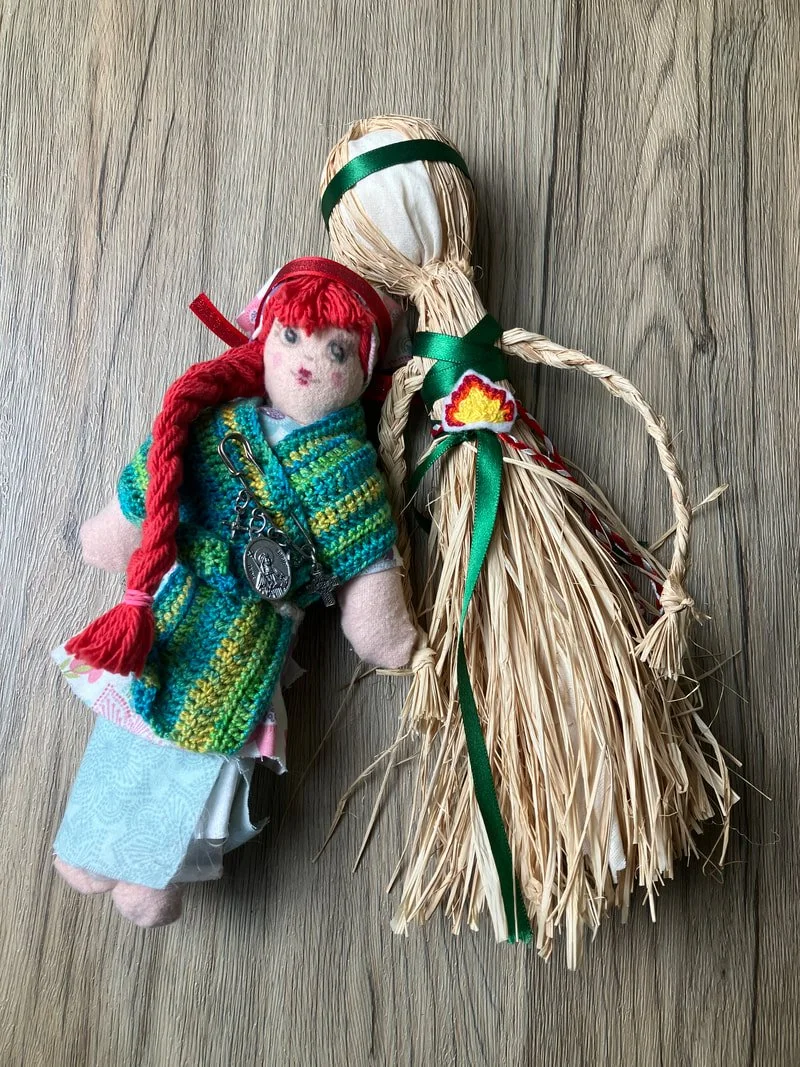
The Brídeóg is not merely a symbol or seasonal craft. It is a body of welcome — a form shaped by your hands that says, “You are invited to dwell here.”
This act establishes relationship immediately.
Before prayers, before poetry, before healing, you make room.
Entering the Practice
Before you begin, pause and speak a few simple words to Brighid — aloud if possible.
Not a spell. Not a list of titles. Just presence.
You might say:
“Brighid, I am here.”
“Brighid, guide my hands.”
“Brighid, you are welcome here.”
Then begin.
The Practice
The Brídeóg should be made by your own hands, with care and attention.
She does not need to be perfect, ornate, or impressive.
This is inspired devotional art — art made as offering, not performance.
Traditional and contemporary forms are all welcome, as long as the act itself is intentional.
You may choose to make her from:
straw, rushes, or dried grasses
cloth, wool, or fabric from your home
yarn, thread, or fiber
a simple bundle of natural materials shaped into human form
Let the materials guide you.
Let the pace be unhurried.
If inspiration arises, follow it.
If simplicity feels right, trust that too.
Closing
When the Brídeóg is finished, hold her briefly and say:
“Brighid, you are welcome here.”
Place her somewhere safe and honored.
She will remain with you through Imbolc.
This marks the beginning of the devotion.
A Devotional Reflection
Brighid is a goddess of inspiration, poetry, and craft.
Creative expression is not separate from devotion — it is one of her sacred languages.
Let this making be alive, sincere, and offered from the heart.
Day 2 (January 14th) — Gazing into the Flame
An Act of Presence and Sacred FireBrighid is a goddess of fire — not only as warmth or light, but as presence.
Today’s practice is not meditation, divination, or vision-seeking.
It is an act of presence.
Light a single flame for Brighid and sit with it quietly.
Let your gaze rest on the fire without forcing meaning or asking for anything in return.
You are not trying to receive messages.
You are allowing your attention to be shaped by her element.
Entering the Practice
When the flame is lit, take a moment to settle your body.
Then speak simply, if you wish:
“Brighid, I sit with your fire.”
No more is needed.
The Practice
Sit with the flame for several minutes.
Let your breath slow.
Let thoughts come and go without following them.
If your gaze softens or shifts, allow it.
If nothing happens, stay anyway.
This is not about experience —
it is about showing up and remaining.
Closing
When the time feels complete, extinguish the flame gently.
Carry the quiet of this practice with you into the rest of the day.
A Devotional Reflection
Before words, before craft, before healing, there is presence.
Brighid’s fire teaches steadiness, presence, and patience.
By sitting with the flame, you are learning how to remain in her company —
a foundation that will support every practice that follows.
Day 3 (January 15th) — Writing a Letter to Brighid
An Act of Address and Devotional SpeechBrighid is a goddess who listens.
Today’s practice is an act of direct address — not prayer in the formal sense, and not journaling for the self, but a deliberate turning toward Brighid through words.
Take time today to write a letter to her.
This is not meant to be poetic or refined unless poetry arises naturally.
It is meant to be honest, present, and spoken toward her.
Entering the Practice
Prepare your space as you have on the previous days.
Light a flame for Brighid.
When you are ready, speak simply:
“Brighid, I write to you.”
Then begin.
The Practice
Write as you would to someone you are building relationship with.
You may speak of:
why you have come to this devotion
what you are carrying as Imbolc approaches
gratitude, uncertainty, longing, or devotion
what you are making room for in your life
There is no need to ask for anything unless it arises naturally.
There is no need to explain yourself.
Let the letter be complete when it feels complete.
Closing
When you have finished, read the letter aloud if you are able.
Then fold or place it somewhere near your altar.
The letter may remain there through Imbolc, or be offered to the fire or land at a later time, as feels right.
Extinguish the flame gently.
A Devotional Reflection
Devotion is not formed through silence alone.
It is shaped by the courage to speak and be heard.
In addressing Brighid directly,
you step out of abstraction
and into relationship.
Day 4 (January 16th) — Listening to Brighid’s Story
An Act of Listening and LineageBrighid is met not only through fire and making, but through remembrance carried by word and voice.
Today’s devotion turns toward Brighid through listening.
Not listening to gather information, but listening as an act of relationship.
Her stories are not meant to be held at a distance.
They are meant to be received.
Entering the Practice
Prepare your space as you have in the previous days.
Light a flame for Brighid.
Have with you one short text connected to her — a story, prayer, poem, or passage you have chosen beforehand.
When you are ready, speak simply:
“Brighid, I am listening.”
The Practice
Read the chosen text slowly, aloud if possible.
Do not analyze.
Do not interpret.
Do not seek meaning.
Listen for:
what draws you without effort
what repeats or lingers
what settles quietly rather than dramatically
When the reading is complete, remain in silence for a few moments.
Allow what you have heard to settle into the body rather than the mind.
This is not study.
It is devotional listening.
Closing
When the practice feels complete, extinguish the flame gently.
Carry one word, image, or phrase from what you heard into the rest of your day,
without needing to define or explain it.
A Devotional Reflection
Lineage is carried through listening.
When you receive her story without grasping,
you place yourself within the remembering.
Brighid has always been speaking.
This devotion teaches you how to hear.
Day 5 (January 17th) — Crafting Brighid’s Cross
An Act of Protection and Hearth TendingBrighid is a guardian of the hearth, whose protection is shaped through care, repetition, and presence.
Today’s devotion is an act of protective making — not performed in fear, but in trust.
Brighid’s Cross is formed by the hands as a sign of guardianship, placed where life is lived and tended.
This is not decoration.
It is an act of quiet keeping.
Entering the Practice
Prepare your space as you have in the previous days.
Light a flame for Brighid.
Have your materials ready. Traditionally, Brighid’s Cross is made from rushes or straw. Where these are not available, pipe cleaners may be shaped in the same traditional form.
Yarn or wool may be used to bind and wrap the cross, strengthening its form and allowing the act of protection to be shaped slowly by the hands.
When you are ready, speak simply:
“Brighid, may your protection dwell here.”
The Practice
Begin forming the cross in the traditional rotating pattern, allowing the shape to emerge through repetition rather than effort.
As the form takes shape:
wrap the center securely
bind the arms with steady, attentive movements
allow your breath to remain calm and unforced
This is not a test of skill.
It is a practice of presence through making.
When the cross is complete, hold it briefly and acknowledge the work done.
If guidance is needed for the traditional form, you may follow a simple visual or written guide here.
Closing
Place Brighid’s Cross in a space of quiet importance — near the hearth, above a doorway, or where you feel her guardianship is needed.
Extinguish the flame gently.
Let the cross remain in place through Imbolc and beyond, as feels right.
A Devotional Reflection
Protection is not always forceful.
Often it is made quietly,
held in place by care and continuity.
In shaping the cross,
you participate in Brighid’s keeping presence —
a guardianship woven through the everyday.
Day 6 (January 18th) — The Practice of Gratitude
An Act of Recognition and Daily TendingBrighid is honored not only through great gestures, but through steady acknowledgment of what is already given.
Once Brighid has been welcomed into the home and into relationship, devotion becomes something that is lived, not only marked.
Gratitude, here, is not a conclusion.
It is a daily hearth practice — a way of keeping awareness warm.
Entering the Practice
Prepare your space as you have in the previous days.
Light a flame for Brighid.
Have a journal, notebook, or loose pages set aside for this purpose.
When you are ready, speak simply:
“Brighid, help me see what is already present.”
The Practice
Begin a gratitude list.
Write a small number of things — three to five is enough — for which you feel genuine gratitude.
These may be simple:
warmth
shelter
nourishment
a moment of rest
a conversation
a quiet strength you noticed
They do not need to be dramatic or spiritualized.
This list is not completed today.
From this point forward, you will return to this list each day, adding to it as part of your ongoing devotion.
It becomes a record of attention — a way of noticing what continues to be held and provided.
Closing
When you have finished writing for today, place the list near your altar or keep it with the other devotional writings that have gathered there.
Extinguish the flame gently.
Carry a sense of quiet recognition with you into the rest of the day.
A Devotional Reflection
The hearth is sustained by what is noticed and tended daily.
Gratitude is not sentiment.
It is a form of seeing —
and what is seen is more carefully kept.
Day 7 (January 19th) — Creating a Sigil on Stone
An Act of Grounding and Hearth MarkingBrighid is honored not only through flame and inspiration, but through the marked places where devotion is lived.
After gratitude has begun to shape your daily awareness, today’s practice grounds that devotion into the physical world.
This is not symbolic decoration.
It is a way of claiming space for what you are tending.
Entering the Practice
Prepare your space as you have in the previous days.
Light a flame for Brighid.
Have a small stone ready — one that feels good in your hand and carries a sense of steadiness.
When you are ready, speak simply:
“Brighid, let this mark hold your presence.”
The Practice
Create a simple sigil or mark on the stone.
This may be:
a line or cross
a spiral or circle
a symbol that has meaning for you
or a mark that arises naturally in the moment
Do not aim for beauty or complexity.
Let the act of marking be slow and intentional.
As you work, remain aware that you are not decorating an object —
you are grounding devotion into matter.
When the sigil is complete, hold the stone briefly in both hands and acknowledge its purpose.
Closing
Place the stone near your hearth, altar, or another central place in your home.
Extinguish the flame gently.
Allow the stone to remain where it can quietly do its work, without explanation or display.
A Devotional Reflection
Devotion deepens when it is given a place.
Marked ground becomes remembered ground,
and what is remembered
is more faithfully tended.
Day 8 (January 20th) — An Act of Kindness
An Act of Care and Outward DevotionBrighid moves from the hearth into the living world through acts of quiet care.
Devotion that is kept only inward eventually grows thin.
Once Brighid has been welcomed, tended, and given place, her presence begins to move outward naturally.
Kindness here is not random.
It is an extension of hearth-keeping — care offered beyond the self.
Entering the Practice
Prepare your space as you have in the previous days.
Light a flame for Brighid.
Take a moment to become still.
When you are ready, speak simply:
“Brighid, let my care move outward.”
The Practice
Today, perform one intentional act of kindness.
This act should be:
genuine
unforced
and offered without expectation of recognition
It may be small or quiet:
helping someone without being asked
offering patience where it is difficult
giving time, attention, or practical care
easing a burden, spoken or unspoken
Do not announce the act as devotional.
Let it be carried out as part of ordinary life.
This is not charity.
It is devotion made visible.
Closing
When the act has been completed, return briefly to your altar.
Extinguish the flame gently.
Do not dwell on the act or measure its impact.
Allow it to be complete.
A Devotional Reflection
The hearth does not keep warmth for itself alone.
What is tended within
naturally offers itself outward.
Through simple kindness,
devotion enters the living world —
quietly,
and without display.
Day 9 (January 21st) — Purification and Healing with Water
An Act of Renewal and Gentle RestorationBrighid heals through water as surely as through flame, restoring what has grown weary through quiet tending.
After gratitude, grounding, and outward care, devotion now turns toward renewal.
This is not dramatic cleansing.
It is gentle restoration — a return to steadiness.
Water here is not used to erase or judge.
It is used to soothe, bless, and support what is living.
Entering the Practice
Prepare your space as you have in the previous days.
Light a flame for Brighid.
Bring a small bowl of clean water to your altar.
When you are ready, speak simply:
“Brighid, let this water carry healing.”
The Practice
Hold your hands over the bowl of water.
Take a few slow breaths, allowing your attention to settle.
Then, using the water:
gently wash your hands, or
touch the water to your forehead, or
hold the bowl close and let the intention be set without touching
Choose what feels right, without forcing meaning.
As you do, remain attentive to sensation —
coolness, weight, movement, presence.
This is not symbolic purification.
It is an act of care for the body and spirit as they are.
When the practice feels complete, pause for a moment in stillness.
Closing
When you are finished, pour the water outside onto the earth, returning it with gratitude.
Extinguish the flame gently.
Carry a sense of quiet renewal with you into the rest of the day.
A Devotional Reflection
Healing does not always arrive as change.
Sometimes it arrives as ease.
When water is used with care,
it reminds the body and spirit
how to return to balance —
slowly,
and without force.
Day 10 (January 22nd) — Wrapped in Her Mantle
An Act of Rest and Sacred HoldingBrighid offers protection not only through action, but through shelter, rest, and being held.
After days of tending, grounding, outward care, and gentle healing, devotion now turns toward rest with purpose.
To be wrapped in Brighid’s mantle is not to escape what you carry —
it is to allow yourself to be held with awareness of what needs rest, safety, or easing.
Entering the Practice
Prepare your space as you have in the previous days.
Light a flame for Brighid.
Have a shawl, blanket, or cloak nearby — something that feels comforting and familiar.
Before wrapping yourself, take a moment to name one intention quietly to yourself.
This may be:
rest from weariness
comfort during uncertainty
protection during a difficult season
easing of grief, strain, or fear
simply the need to feel held
When you are ready, speak simply:
“Brighid, I place this intention in your keeping.”
The Practice
Wrap the shawl or blanket around your shoulders.
Sit or lie down in a position that allows your body to soften.
Let your breath slow naturally.
There is nothing to visualize and nothing to accomplish.
Allow your intention to rest with you, without revisiting or analyzing it.
Remain here quietly for several minutes, receiving warmth, weight, and stillness.
This is not meditation.
It is rest with awareness.
Closing
Wrap the shawl or blanket around your shoulders.
Sit or lie down in a position that allows your body to soften.
Let your breath slow naturally.
There is nothing to visualize and nothing to accomplish.
Allow your intention to rest with you, without revisiting or analyzing it.
Remain here quietly for several minutes, receiving warmth, weight, and stillness.
This is not meditation.
It is rest with awareness.
A Devotional Reflection
Rest becomes sacred when it is chosen with honesty.
When you name what you are carrying
and allow yourself to be held anyway,
you practice trust —
not as belief,
but as embodied experience.
Day 11 (January 23rd) — Tending the Hearth Space
An Act of Readiness and CareBrighid is honored where the hearth is kept in order and made ready for what may come.
After gratitude, grounding, outward care, purification, and being held, devotion now turns toward readiness.
Not rest.
Not inward listening.
But the quiet work of keeping the space where devotion lives.
This is not symbolic.
It is practical, embodied, and deeply devotional.
Entering the Practice
Prepare your space as you have in the previous days.
Light a flame for Brighid.
Stand or sit for a moment and look at the space where your devotion has been taking place — the altar, hearth, or central area of your home.
When you are ready, speak simply:
“Brighid, I tend the place where you are welcomed.”
The Practice
Tend the hearth space.
This may include:
clearing dust or clutter
straightening what has shifted
refreshing water or offerings
removing items that no longer belong
adjusting the space so it feels cared for and ready
Work slowly and deliberately.
Do not rush.
Do not treat this as a chore.
As you tend the space, remain aware that this is devotion expressed through care, not through prayer or vision.
When the space feels settled and complete, pause and acknowledge the work done.
Closing
Step back from the hearth space.
Extinguish the flame gently.
Allow the space to stand as it is — ordered, tended, and ready — without adding anything more.
A Devotional Reflection
Devotion is sustained where care is given regularly.
A tended hearth does not call attention to itself.
It simply remains ready.
When the space is kept,
what is meant to arrive
can do so without strain.
Day 12 (January 24th) — Writing Affirmations
An Act of Spoken Alignment and IntentionBrighid shapes what is becoming through words spoken with care and consistency.
The hearth has been welcomed, tended, grounded, and made ready.
Now devotion begins to speak forward — not from effort, but from relationship.
These words are not wishes.
They are not declarations of perfection.
They are statements you are willing to live inside.
Entering the Practice
Prepare your space as you have in the previous days.
Light a flame for Brighid.
Take a moment to stand or sit upright, allowing your breath to settle.
When you are ready, speak simply:
“Brighid, shape my words in truth.”
The Practice
Write three affirmations, in the present tense.
These affirmations should be:
clear
simple
grounded
and truthful enough to be spoken daily
They may speak to:
the way you are choosing to live
the qualities you are cultivating
the relationship you are tending
the work that is forming quietly within you
If it is helpful, the following are offered as examples of tone, not words to adopt:
I tend what has been entrusted to me with care and steadiness.
My words and actions arise from presence rather than urgency.
What I am becoming unfolds with integrity and patience.
These are not meant to be copied.
They simply demonstrate the restraint and clarity this practice asks for.
Once written, read your three affirmations aloud, slowly and clearly.
These three affirmations are to be spoken each day for the remainder of this devotion.
They are not to be revised, expanded, or replaced.
They become a spoken thread that carries through the days that follow.
Closing
Place the affirmations near your hearth space, altar or keep them with you.
Extinguish the flame gently.
Let the words continue working quietly, without forcing them.
A Devotional Reflection
Words spoken once may inspire.
Words spoken faithfully shape.
When you return to the same words each day,
you allow them to become a forge —
forming what is ready
through repetition rather than will.
Day 13 (January 25th) — Writing a Poem or Prayer
An Act of Inspiration and OfferingBrighid kindles inspiration where devotion has been faithfully tended.
After days of care, readiness, and spoken alignment, inspiration now arises without being forced.
Today’s practice is not about artistry or eloquence.
It is about offering voice to what has quietly taken shape.
This is not self-expression.
It is devotion given form.
Entering the Practice
Prepare your space as you have in the previous days.
Light a flame for Brighid.
Take a moment to return to the three affirmations you have been speaking.
Let them settle in your body.
When you are ready, speak simply:
“Brighid, let what is true find its voice.”
The Practice
Write either:
a poem, or
a prayer
There is no required length.
There is no required style.
You may:
write in complete sentences or fragments
repeat words or phrases
allow the writing to move slowly or quickly
Do not revise as you write.
Do not shape the offering for beauty or meaning.
Let the words arise from:
what has been tended
what has been spoken daily
what has begun to stir
When the writing naturally comes to an end, stop.
Closing
Read the poem or prayer aloud, if you are able.
Then place the writing near your hearth space with the other offerings that have gathered there.
Extinguish the flame gently.
Allow the offering to stand as it is, without judgment or correction.
A Devotional Reflection
Inspiration does not arrive on command.
It emerges where devotion has been kept steady.
When words are offered without striving,
they become part of the living current —
voice shaped by relationship,
and given freely.
Day 14 (January 26th) — A Devotional Meditation to Meet Brighid
An Act of Encounter and PresenceBrighid is met through readiness, not summoning — through presence, not pursuit.
You have welcomed, tended, spoken, offered, and given voice.
Now devotion becomes availability.
This is not imagination and not vision-seeking.
It is the act of showing up without demand, allowing encounter to take whatever form is given — or none at all.
Entering the Practice
Prepare your space as you have in the previous days.
Light a flame for Brighid.
Sit upright but at ease, allowing your body to settle without strain.
When you are ready, speak simply:
“Brighid, I am present.”
The Practice
Close your eyes, or soften your gaze.
Bring your attention first to the body —
the weight of yourself where you are seated,
the rhythm of your breath,
the steady presence of the flame.
When your attention feels settled, allow yourself to become aware of a threshold.
Do not decide what this threshold is.
Do not shape or imagine it deliberately.
Simply notice that you are near something that may be crossed — or simply stood beside.
Remain attentive rather than active.
If Brighid becomes known — through image, sensation, word, emotion, or quiet knowing — receive what is given without reaching for more.
If nothing distinct occurs, remain anyway.
Presence itself is the devotion.
Stay for as long as feels appropriate, without forcing time.
When the meditation feels complete, gently return your awareness to the room.
Closing
Open your eyes slowly.
Extinguish the flame gently, or leave it burning safely if that is your custom.
Do not interpret what occurred.
Do not measure the experience.
Allow the meeting — or the waiting — to stand as it is.
A Devotional Reflection
Encounter does not always arrive as vision.
Sometimes it arrives as steadiness,
or as the quiet certainty that you were not alone.
Devotion deepens not by grasping,
but by remaining present
without demand.
Day 15 (January 27th) — Journaling Transformation
An Act of Shaping and Inner ForgeBrighid works through the slow shaping of what is ready to change.
After words have been spoken, offered, and received, devotion now turns toward formation.
Not explanation.
Not analysis.
But the quiet work of noticing what is being reshaped.
Entering the Practice
Prepare your space as you have in the previous days.
Light a flame for Brighid.
Have your journal or paper ready.
When you are ready, speak simply:
“Brighid, show me what is being formed.”
The Practice
Begin writing without deciding where you will go.
You may reflect on:
what has shifted since beginning this devotion
what feels stronger, softer, or newly unsettled
what is loosening its hold
what is quietly taking shape
Do not correct yourself as you write.
Do not search for conclusions.
Allow the writing to move at its own pace.
This is not about insight.
It is about giving shape to movement.
When the writing naturally comes to a pause, stop.
Closing
Read over what you have written once, without judgment.
Then close the journal or place the pages near your hearth space.
Extinguish the flame gently.
Let what has been shaped remain incomplete.
A Devotional Reflection
Transformation rarely announces itself.
It is recognized through attention —
through the willingness to notice
what no longer fits
and what is quietly becoming.
In tending the inner forge,
change is guided
by care rather than force.
Day 16 (January 28th) — Remembering How You Met Brighid
An Act of Memory and RecognitionBrighid is often known first through memory — through the moment we realize she has already been present.
Before devotion turns fully outward toward blessing and circulation, it pauses here —
to remember.
This is not nostalgia.
It is recognition.
Memory, in devotion, is not backward-looking.
It is a way of seeing the threads that were already woven before you named them.
Entering the Practice
Prepare your space as you have in the previous days.
Light a flame for Brighid.
Sit comfortably with a journal or paper nearby.
When you are ready, speak simply:
“Brighid, help me remember.”
The Practice
Recall the first time you became aware of Brighid’s presence in your life.
This may have been:
a moment of curiosity
a pull toward her stories or symbols
an unexpected recognition
a season when her name began to matter
Begin writing about that moment.
Let memory move naturally:
where you were
what was happening in your life
what you felt or noticed
what has changed since then
Do not polish the memory.
Do not try to make it meaningful.
Let it be remembered as it was, not as you wish it had been.
This is not about interpretation.
It is about acknowledgment.
When the memory has been written, pause.
Closing
Read what you have written once, slowly.
Then place the pages near your hearth space or keep them folded with your other devotional writings.
Extinguish the flame gently.
Carry the sense of recognition with you into the rest of the day.
A Devotional Reflection
Devotion deepens when we recognize
that what we are entering
has already been walking with us.
Memory reveals continuity —
and continuity
is one of Brighid’s quiet gifts.
Day 17 (January 29th) — Gratitude for What Brighid Has Brought
An Act of Acknowledgment and BlessingBrighid is honored when what has been given is named and received with clarity.
After welcome, tending, listening, inspiration, and remembering, devotion now turns toward acknowledgment.
Not general gratitude, but specific recognition.
This is the moment to look back over the days you have kept —
and to name what has actually arrived.
Entering the Practice
Prepare your space as you have in the previous days.
Light a flame for Brighid.
Have your journal or paper ready.
When you are ready, speak simply:
“Brighid, I acknowledge what you have brought.”
The Practice
Review the days of this devotion.
Notice what has changed, deepened, softened, or become clearer.
Do not search for dramatic transformation.
Write a list — or a short reflection — naming specific things you recognize as gifts.
These may include:
shifts in attention or understanding
moments of steadiness or comfort
insight that arrived quietly
protection, clarity, or strength
a sense of relationship more fully formed
Let this be honest and grounded.
You are not required to feel grateful for everything —
only to name what you can truly recognize.
When the writing feels complete, pause.
Closing
Read what you have written once, slowly.
Then place it with your other devotional writings near the hearth space.
Extinguish the flame gently.
Carry the awareness of what has been received into the rest of the day.
A Devotional Reflection
Gratitude deepens devotion
when it is specific and sincere.
To name what has been given
is to recognize relationship —
and recognition
is itself a form of blessing.
Day 18 (January 30th) — Prayers for Others
An Act of Intercession and Shared CareBrighid carries devotion outward when care is offered on behalf of others.
As Imbolc draws near, what has been tended within now circulates.
This is not about taking on burdens or fixing what is not yours to hold.
It is about bearing witness through prayer — steady, respectful, and uncluttered.
Intercession here is simple presence offered for another’s well-being.
Entering the Practice
Prepare your space as you have in the previous days.
Light a flame for Brighid.
Have a list ready — written or held quietly — of those for whom you wish to pray.
When you are ready, speak simply:
“Brighid, receive these names into your care.”
The Practice
One by one, name those you are holding in prayer.
You may include:
family or friends
those who are ill or weary
people facing uncertainty or hardship
communities in need
those whose names you do not know
After each name, pause briefly.
You do not need to ask for specific outcomes.
Let the prayer be care offered, not direction given.
If words come, allow them.
If silence comes, allow that too.
Closing
When all names have been held, pause in stillness.
Extinguish the flame gently.
Release the prayers without revisiting them, trusting they have been received.
A Devotional Reflection
Care offered for another
loosens the boundary of the self.
When prayer is given without grasping,
it becomes a quiet current —
moving where it is needed
without being forced.
Day 19 (January 31st) — Imbolc Eve: Bhrat, Hearth, Reflection
An Act of Completion and ReturnBrighid is welcomed not only in beginning, but in readiness — when the house and heart are prepared to receive her.
This is the eve of Imbolc.
The devotion now turns from practice into presence.
Nothing new is added today.
What has been tended, spoken, remembered, and offered is allowed to settle.
Entering the Practice
Prepare your space with care.
Light a flame for Brighid.
If you keep a Bríde’s Brat or cloth for blessing, place it near the hearth or altar.
If you do not use a brat, simply let the hearth space stand open and ready.
When you are ready, speak simply:
“Brighid, my home is ready.”
The Practice
Spend time at the hearth.
Review the devotion quietly:
the practices you kept
the words you spoke daily
the care you offered
the changes you noticed
the relationship you tended
You may:
sit in stillness
read over your writings
hold the Brídeóg or Bríde’s Cross
place the brat where it will rest overnight
Do not analyze or interpret.
Let the devotion be received rather than reviewed.
If words arise naturally, allow them.
If silence remains, honor it.
Closing
Before ending the practice, acknowledge Brighid with gratitude.
Extinguish the flame gently, or leave it burning safely if that is your custom for Imbolc Eve.
Let the hearth stand ready through the night.
A Devotional Reflection
Completion is not an ending.
It is a return.
What has been tended now belongs to the rhythm of the year —
carried forward not through effort,
but through relationship.
The hearth is ready.
The way is open.