Keening & Grief

Embracing Brighid through the depth of grief.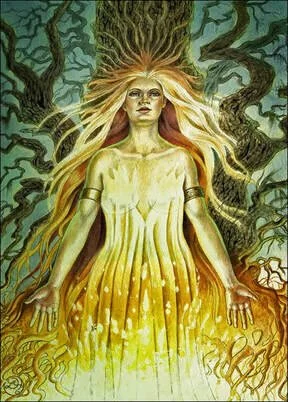
Many do not immediately think of Brighid as one to turn to in times of grief.
She is so often remembered for new beginnings, birth, life, light, and creation.
Yet it was in the midst of my own deepest sorrow that I came to know Her most profoundly.
Grief has a way of stripping us down to what is essential.
It carries us into places we did not choose and did not prepare for — places where brightness feels distant and words fail. It is there, in that rawness, that Brighid reveals another face of Her presence.
Brighid is not only the flame that kindles new life.
She is also the one who keeps vigil in the dark.
In the old stories, Brighid herself knows loss. She keens for her son, her lament said to be the first keening heard in Ireland. Through her mourning, she teaches that grief is not a weakness to be overcome, but a sacred response to love. Keening becomes prayer. Tears become offering. Sorrow becomes a bridge rather than a dead end.
When grief enters our lives, Brighid does not turn away.
She walks with us into that valley — steady, present, unflinching.
She tends the fire when our own hands are too weary to hold it. She sits beside us when there is nothing to fix and no words that will soothe.
Grief, in Her keeping, becomes initiation.
It changes us. It reshapes how we listen, how we love, how we tend what is fragile. Through grief, we are widened. Through grief, we are taught compassion that cannot be learned any other way. Brighid’s presence in sorrow does not erase the pain — but it gives it meaning, dignity, and a place within the larger weaving of life.
This path is not about moving on.
It is about moving with.
Brighid holds those who grieve beneath Her mantle.
She honors what has been lost.
She honors what has been loved.
And she teaches us how to carry both without closing our hearts.
If you are grieving, Brighid walks with you.
Brighid and the First Keening
It is said that it was the Goddess Brighid who first brought keening into the world.
In the great Battle of Moytura, Brighid appears as the wife of Bres of the Fomorians — the mythic adversaries of the Tuatha Dé Danann, the People of the Goddess Danu. Through this union, Brighid stood between two warring peoples, bound by kinship to both, moving as a living bridge across divided worlds.
Her son, Ruadán, was raised among his mother’s people, the Tuatha Dé Danann, and was taught the sacred arts of smithcraft and weapon-making. Yet when the battle came, Ruadán chose to fight on behalf of his father’s kin, the Fomorians. In the clash of forces, he struck a grievous blow against the great smith of the Tuatha Dé Danann. Mortally wounded, the smith returned the strike with his remaining strength, and Ruadán fell.
When Brighid learned of her son’s death, she lifted her voice in mourning.
Her cries of anguish and lament rose over the battlefield, and it is said that this was the first time wailing and keening were ever heard in Ireland. From her grief came a tradition that has carried through generations — the sacred cry of mourning that gives voice to sorrow when words cannot.
In Brighid’s keening, grief was no longer silent.
It became sound, breath, and release.
What she voiced in sorrow, humanity has carried ever since.
What is Keening?
Keening is an ancient form of lament — an intense, mournful expression of grief offered after a death. In the Gaelic Celtic tradition, keening was voiced in Irish or Scots Gaelic at the wake or graveside, a ritual of sorrow carried on the breath and through the body. The word itself comes from the Gaelic caoineadh (kween-ith), meaning “to cry” or “to weep.”
Keening does not always take the form of piercing screams or loud cries. It may rise as a howl, a sob, a whisper, or even a gentle whimper. The essence of keening is not found in its volume, but in its truth — the willingness to enter grief fully and allow what cannot be spoken to be released.
In times of profound sorrow, Brighid may also be found through the flame of creativity. She is present wherever pain is shaped into expression — through voice, movement, making, or prayer. Grief may move through writing or song, through image or craft, through stillness or sound.
What matters is not the form grief takes, nor whether it is witnessed by others, but that it is allowed to move. When sorrow is given space, it softens its hold. In this movement, Brighid walks with us — not to take grief away, but to help us carry it with dignity and care.